
 Business License

Powder Coating Oven: A Manufacturer's Guide to Selection, Sizing, and Energy Efficiency
A powder coating line is only as reliable as its curing stage. Choose the wrong powder coating oven, and even the most precise electrostatic spray application will produce orange peel, poor adhesion, or color inconsistency. Yet buyers routinely spend months evaluating spray booths and reciprocators, then treat the oven as a simple box that heats metal.
That assumption is expensive.
The curing oven determines final film properties, energy consumption, and production rhythm. In this guide, you will learn how to select the right powder coating oven for your application, size it for your workpieces and throughput, compare gas, electric, and infrared heating, and avoid the specification mistakes that lead to rework and downtime. Whether you are planning a new electrostatic powder coating line or upgrading an existing curing stage, the decisions below will help you specify equipment that delivers consistent results from the first production run.
Deqing Leixin Coating Equipment Co., Ltd. designs and commissions turnkey coating systems, and every line we deliver includes a curing stage matched to the customer's workpiece dimensions, daily output, and local energy infrastructure.
What Is a Powder Coating Oven and Why Does It Matter?
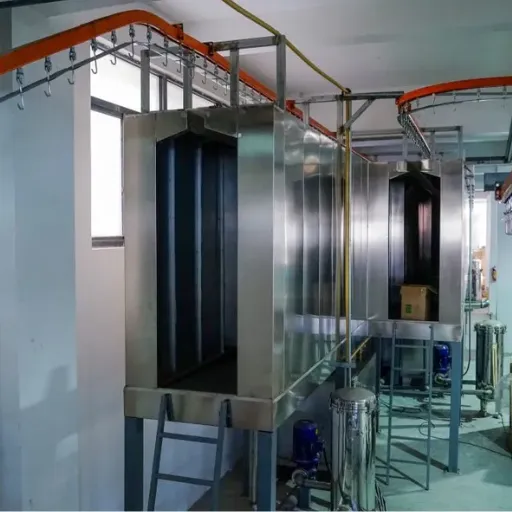
A powder coating oven is an enclosed thermal chamber that heats coated metal workpieces to the cure temperature specified by the powder supplier, generally between 160°C and 220°C. Over a controlled dwell time, usually 10 to 30 minutes, the powder particles melt, flow, and chemically cross-link into a continuous, durable film.
Uniformity matters more than peak temperature. A quality curing oven maintains temperature variation within ±3°C throughout the work zone and provides consistent airflow so every surface reaches the cure window at the same time. Hot spots cause overbake, while cold zones leave powder under-cured and prone to chipping or poor adhesion.
The oven is also the largest energy consumer on most powder coating lines. Heating source selection, insulation quality, and airflow design directly affect operating cost per part. In practice, the oven choice can have a bigger impact on total cost of ownership than the spray booth itself.
Engineering Note: Always verify the powder supplier's cure schedule before specifying oven temperature and dwell time. Low-temperature powders may cure at 140°C, while high-performance architectural powders may require 200°C or more.
Need help matching a powder coating oven to your line? Request a free design drawing from our engineering team.
Types of Powder Coating Ovens
Powder coating ovens fall into four main categories: batch, conveyorized tunnel, infrared, and bridge-type. The right choice depends on production volume, workpiece size, line integration, and available floor space.
Batch Powder Coating Ovens
Batch ovens are standalone units loaded manually or with a forklift. They suit job shops, prototype work, and low-to-medium production volumes where part variety changes frequently. A batch powder coating oven offers flexibility, but throughput is limited by the time required to load, heat, cure, cool, and unload each batch.
A curing oven for powder coating may be as small as a walk-in unit or as large as a truck-in chamber. When specifying a batch oven, consider the largest workpiece envelope, maximum batch weight, and required cure time. The oven interior must allow adequate clearance around parts so heated air can circulate on all sides.
Conveyorized Tunnel-Type Curing Ovens
A tunnel-type curing oven is integrated into a continuous powder coating production line. Workpieces enter on a conveyor, travel through heated zones at a controlled speed, and exit cured and ready for cooling. These ovens match high-volume operations because cure time becomes a function of conveyor speed and heated length.
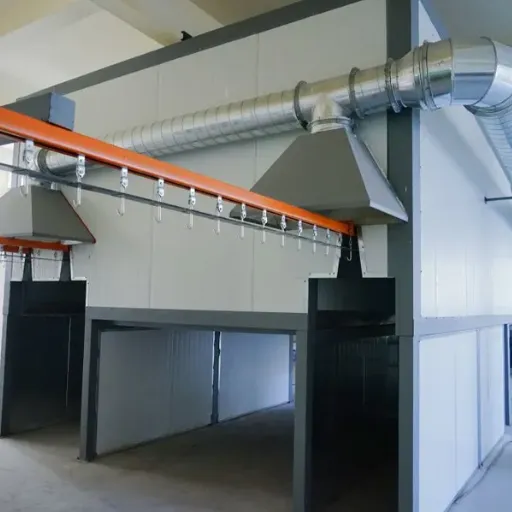
Tunnel ovens can be straight, U-shaped, or bridge-type depending on factory layout. A tunnel type curing oven design is common in automotive, appliance, and furniture finishing. A well-designed overhead conveyor system synchronizes workpiece movement with pretreatment, spray, cure, and cooling stages.
Infrared Curing Ovens
Infrared (IR) curing ovens use radiant energy rather than heated air to raise the part surface temperature. They heat rapidly and can reduce cure time from minutes to seconds for compatible geometries. IR is most effective on simple, flat, or regularly shaped workpieces where line-of-sight exposure is consistent. Complex shapes with recesses or shadowed areas may need a complementary convection stage to avoid uneven cure.
Bridge-Type Curing Ovens
A bridge-type curing oven suspends the heated chamber above the conveyor, creating a physical barrier that reduces contamination from the shop floor. This design is common in high-quality finishing environments where dirt or dust could settle on uncured powder.
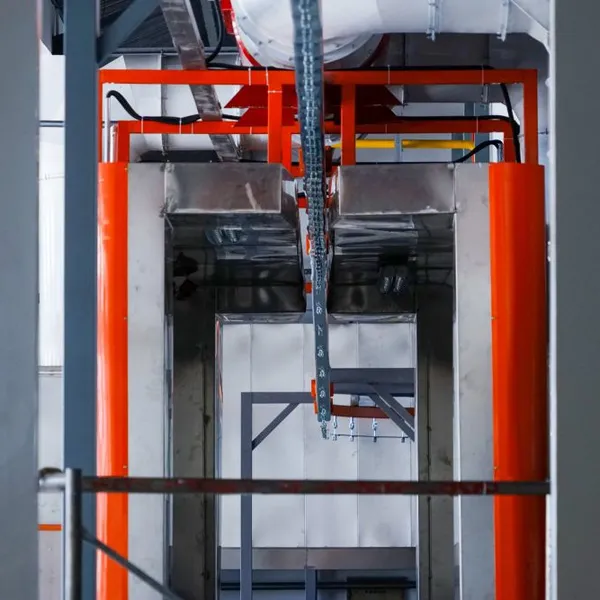
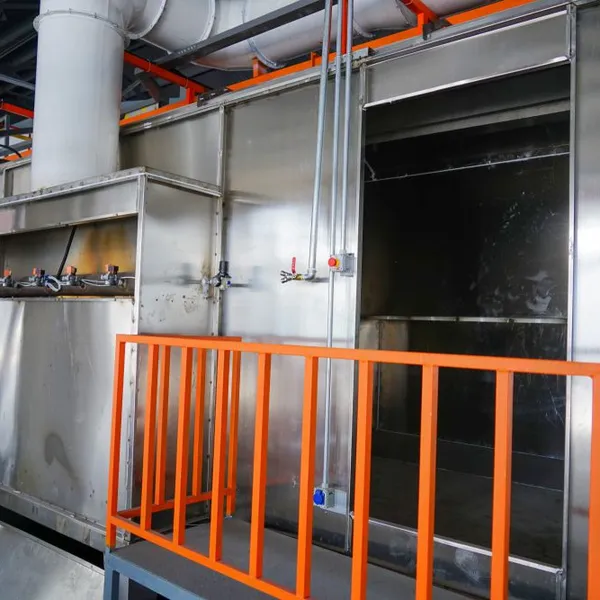
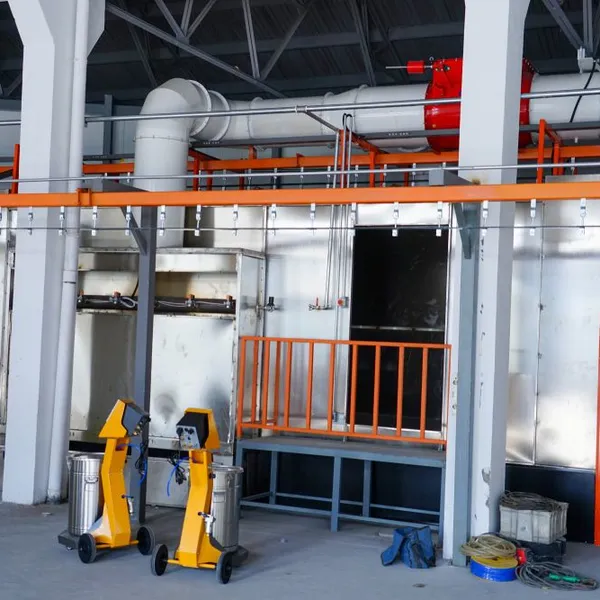
A tunnel-type curing oven with stainless steel liner and multi-energy heating options moves parts through a controlled temperature profile.
Gas vs Electric vs Infrared: Selecting the Right Heating Source
Heating source is one of the most consequential decisions in oven specification. Each option has distinct capital cost, operating cost, maintenance, and environmental profiles.
| Heating Source | Best For | Typical Operating Cost | Temperature Control |
|---|---|---|---|
| Gas fired | High-volume lines with natural gas access | Lower per kcal in most regions | Excellent with modulating burner |
| Electric | Smaller batch ovens, precise control, low emissions | Higher per kcal unless electricity is cheap | Very precise, ±1°C possible |
| Infrared | Compatible flat parts, rapid cure, energy spikes | Low when used selectively | Fast response, line-of-sight dependent |
Gas Fired Curing Ovens
A gas fired curing oven uses direct or indirect burners to heat combustion air. Gas ovens generally offer the lowest operating cost where natural gas is available and are preferred for large tunnel ovens with high thermal demand. Direct-fired units are efficient but introduce combustion products into the oven atmosphere, so indirect-fired designs are used when part contamination is a concern.
Electric Curing Ovens
An electric curing oven uses resistance heating elements. Capital cost is usually lower, installation is simpler, and emissions at the point of use are zero. Electric ovens excel in batch operations, clean-room environments, and regions where electricity is subsidized or gas infrastructure is limited. The trade-off is typically higher energy cost per part at high volumes.
Infrared Powder Coating Oven Applications
An infrared powder coating oven can be used as a booster before a convection oven or as a standalone cure unit for simple parts. The rapid response reduces warm-up time and can cut overall energy use because only the part surface is heated, not the entire oven volume.
When Maria, a production supervisor at an automotive parts supplier in Mexico, switched her batch operation from an electric curing oven to a gas-fired tunnel oven, her energy cost per cured part fell by 35%. The ±3°C uniformity of the new oven also reduced film-thickness variation, cutting rework from 8% to under 3% within one quarter.
Not sure which heating source fits your local energy costs? Speak with a coating engineer about gas, electric, and infrared options for your line.
How to Size a Powder Coating Oven for Your Production Line
Sizing starts with data, not guesses. The oven must handle the largest workpiece envelope, absorb the thermal load of incoming parts and hangers, maintain the cure temperature, and deliver the required throughput.
Start with the Workpiece Envelope
Measure the maximum length, width, and height of a loaded part or rack. Add clearance on all sides for airflow. For a tunnel oven, this envelope determines the cross-sectional opening. For a batch oven, it determines the chamber interior.
Calculate Throughput and Dwell Time
Throughput is parts per hour. Dwell time is the minutes required at cure temperature. For a tunnel oven, the required heated length equals:
Heated length (m) = conveyor speed (m/min) × dwell time (min)
If you need 15 minutes at temperature and the conveyor moves at 2 m/min, the heated zone must be at least 30 m long. Add loading and unloading transition zones.
Estimate Thermal Load
Thermal load includes:
Heat required to raise parts and hangers to cure temperature
Heat lost through insulation and exhaust
Heat needed to maintain temperature during loading
A heavy steel rack absorbs energy. Lightweight aluminum parts heat quickly but may require shorter dwell times. The oven supplier uses this data to specify burner or heating element capacity, expressed in kcal/h or kW.
Chen, a plant manager at an aluminum extrusion company in Vietnam, originally specified a batch oven sized for small hardware. When his window-frame profiles grew to 2,400 mm, parts had to be cured in two batches. A tunnel-type curing oven sized to the new envelope eliminated the double-handling and reduced per-piece cure time by 40%.
For a complete layout that includes pretreatment, spray, and cure stages, see our powder coating line design guide.
Key Specifications and Quality Standards
Once you know the type and size, evaluate the engineering details that determine long-term performance. Industry organizations such as the Powder Coating Institute publish curing guidelines, while ASTM and ISO 9001:2015 standards help define testing methods and quality management.
Temperature Uniformity and Control
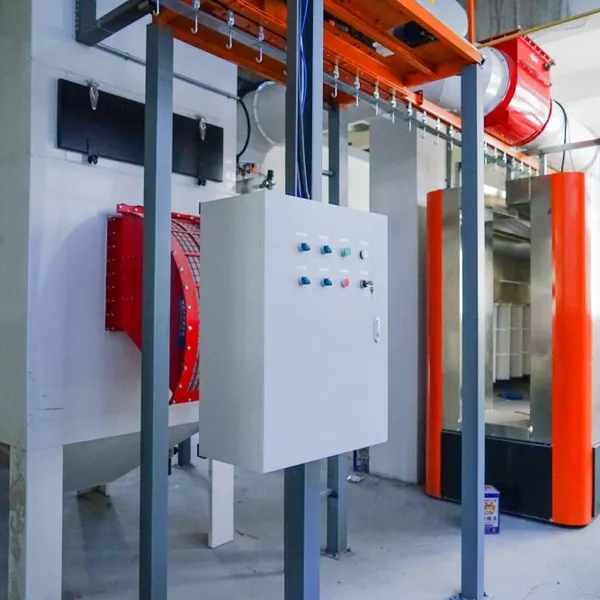
Look for temperature uniformity within ±3°C across the work zone. A Programmable Logic Controller (PLC) with touch-screen Human-Machine Interface (HMI) allows operators to store recipes, monitor trends, and receive alarms. Some systems offer remote large-screen displays for production visibility.
Insulation and Construction
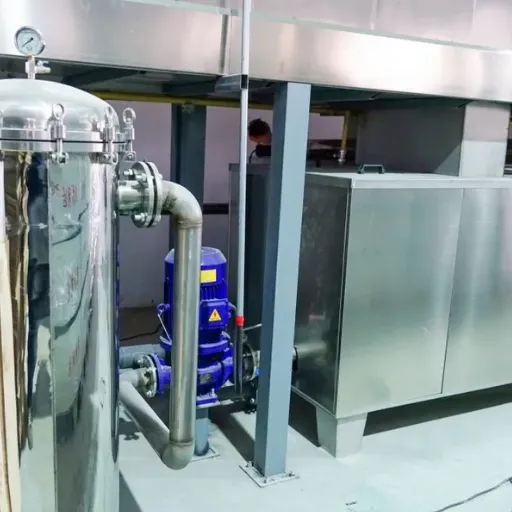
High-quality ovens use mineral wool or ceramic insulation to minimize heat loss. A 304 stainless steel liner resists corrosion and is easier to clean than coated carbon steel. Insulated doors with positive latches reduce leakage in batch ovens.
Airflow Design
Convection ovens rely on recirculating fans to move heated air evenly. Fan placement, ducting, and baffles prevent dead zones. Exhaust airflow must be sufficient to remove volatiles and combustion products without pulling excessive heat out of the chamber.
Heating Capacity
Thermal capacity is often expressed in kilocalories per hour (kcal/h) for gas ovens or kilowatts (kW) for electric ovens. Tunnel ovens for production lines commonly range from 300,000 to 1,000,000 kcal depending on throughput and part load. Match capacity to the worst-case production scenario, not the average.
Safety and Compliance
Ovens should include over-temperature protection, flame safeguards, emergency stops, and proper ventilation. When quoting equipment for export, confirm that electrical, gas, and emissions components meet local codes. Deqing Leixin builds ovens to customer specifications and can adapt controls for regional standards.
Common Mistakes When Buying a Powder Coating Oven
Avoid these specification errors that we see in the field repeatedly.
Undersizing the oven to save capital cost. A small oven creates bottlenecks and forces smaller batches, increasing labor cost per part.
Ignoring the thermal mass of racks and fixtures. Heavy hangers act as heat sinks and extend heat-up time.
Choosing heating source without an energy audit. Local gas and electricity prices vary widely; the cheapest capital option is not always the lowest total cost.
Specifying peak temperature without uniformity. A ±10°C variation can produce visible color shifts and adhesion failures.
Neglecting maintenance access. Burners, fans, filters, and control panels need clearance for service.
Maintenance for Long-Term Reliability
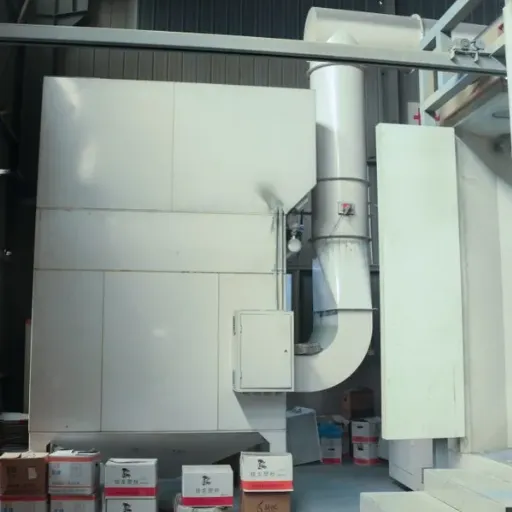
A powder coating oven will run for years if it receives basic preventive maintenance. The following schedule keeps performance within specification:
Daily: Inspect door seals, check exhaust airflow, and remove powder buildup near thresholds.
Weekly: Clean or replace intake filters, verify temperature recorder readings, and check burner flame patterns.
Monthly: Lubricate fan bearings, inspect heating elements or burners, and calibrate temperature sensors.
Quarterly: Test safety interlocks, measure temperature uniformity across the work zone, and review PLC alarm history.
At a hardware manufacturer in Turkey, neglected circulation fans created a 7°C gradient across the batch oven. Rejects climbed to 12% before the team introduced a quarterly fan and filter inspection program. Within two months, rework fell to 4% and energy consumption dropped because the oven no longer over-compensated for cold zones.
For related process support, our surface pretreatment system ensures parts enter the oven clean and ready for a durable finish.
Conclusion
The powder coating oven is not an afterthought; it is the stage that locks in adhesion, appearance, and durability. Selecting the right type, sizing it for your largest workpiece and throughput target, choosing the most cost-effective heating source, and insisting on tight temperature uniformity will protect your coating investment for years.
Key takeaways:
Match oven type to volume: batch ovens for flexibility, tunnel ovens for continuous production, infrared for compatible rapid-cure parts.
Size for the worst-case workpiece envelope, rack weight, and dwell time.
Compare gas, electric, and infrared based on local energy prices and emissions requirements.
Demand ±3°C uniformity and PLC-based temperature control.
Schedule preventive maintenance to avoid drift and rejects.
Ready to specify a powder coating oven for your line? Get a turnkey project quotation and submit your workpiece specifications. Our engineers will respond within 3 hours with a preliminary design and energy recommendation.
Recently Posted
-
Conveyor Speed Calculation for Coating Lines: A Complete Guide
June 26, 2026Last March, a hardware manufacturer in Ningbo raised the chain speed on its powder coating line by 15% to clear a backlog. Three d Read More
 -
Conveyor Line Design: A Complete Engineering Guide for Coating Lines
June 26, 2026Last autumn, a hardware manufacturer in Vietnam commissioned a new powder coating line. The pretreatment tunnel, cyclone-recovery Read More
 -
Overhead Conveyor System: Engineering Guide for Coating Lines
June 26, 2026Last autumn, a hardware manufacturer in Ningbo faced a familiar problem. Their new powder coating line had to fit inside a buildin Read More
 -
Industrial Paint Booth: A Complete Engineering Guide for Manufacturers
June 26, 2026When Mike Chen expanded his metal furniture factory in Zhejiang Province last spring, he assumed the new spray area would solve hi Read More

Contact Us
Recommended Products
-
 Industrial Custom Spray Coating Line for Hardware Anti‑Corrosion TreatmentNegotiableMOQ: 1 Set
 -
Industrial Electrophoresis Line for Metal Water Pump Workpieces ProcessingNegotiableMOQ: 1 Set
-
Custom E‑Coating Production Line for Water Pump Parts Surface FinishingNegotiableMOQ: 1 Set
-
China OEM Custom E-Coating Machine and Cathodic Electrophoresis Production LineNegotiableMOQ: 1 Set
-
Industrial Electrophoretic Coating Line With Custom Design for Metal WorkpiecesNegotiableMOQ: 1 Set
-
Intelligent Automated Electrophoretic Coating Line for Powder Coating Production EquipmentNegotiableMOQ: 1 Set
-
Full Automatic Custom Electrophoretic Coating Line for Industrial Metal ComponentsNegotiableMOQ: 1 Set
-
Heavy‑Duty Continuous Powder Coating Line for Big Cabinet Anti‑Corrosion FinishingNegotiableMOQ: 1 Set
-
Energy‑Saving Powder Coating Line for Large Industrial Cabinet Surface ProtectionNegotiableMOQ: 1 Set
-
Environmental Friendly Powder Coating Line With High Recovery for Large CabinetsNegotiableMOQ: 1 Set
-
Large Manual Industrial Curing Oven for Metal Powder Coating MachineryNegotiableMOQ: 1 Set
-
Industrial Plastic Drying Oven With PLC Control and 304 Stainless Steel HopperNegotiableMOQ: 1 Set
-
High Efficiency Plastic Raw Material Dryer for Plastic ProcessingNegotiableMOQ: 1 Set
-
Compact E-Coating System for Small Metal Components in Automotive & Medical Device ProductionNegotiableMOQ: 1 Piece
-
Gantry Transport Type Electrophoretic Coating Line for Industrial WorkpiecesNegotiableMOQ: 1 Set
-
Custom Gantry Electrophoretic Coating Line for Automotive Component FinishingNegotiableMOQ: 1 Set
-
Large Workpiece Stainless Steel Manual Powder Spray Booth With Ventilation SystemNegotiableMOQ: 1 Set
-
Large Capacity Stainless Steel Manual Powder Spray Booth With Powder Recovery SystemNegotiableMOQ: 1 Set
-
Automatic Large Workpiece Powder Spray Booth for Metal FabricationNegotiableMOQ: 1 Set
-
Powder Spraying Room With Stainless Steel Frame and PLC ControlNegotiableMOQ: 1 Set